History of the parish
On May 7, 1836, the Gromadzka council of Zakopane submitted an application to the authorities of the Austro-Hungarian Galicia to conduct a mission by the Jesuits from Nowy Sącz and to establish a new parish due to the too large area of the Zakopane parish. The same year, a visitation by Bishop Franciszek Ksawery took place. After the missions, the Jesuits presented the necessity of creating a parish to the bishop ordinary in Tarnów. The parish was established in 1845.
Due to the Galician and Chochołowski uprisings, the canonical installation of Father Józef Stolarczyk at the old church of St. Clement in Zakopane was officially carried out only in 1848. At that time, Kościelisko as a municipality was part of the Chochołów parish.
Only between 1910 and 1916 did an independent pastoral care emerge in Kościelisko under the invocation of St. Casimir. It covered the area: Krzeptówki - Sobiczkowa - Kiry - Witów - Roztoki. After fulfilling legal requirements, Cardinal Puzyna established the Kościelisko parish, and after 1918 it was finally approved by the Ministry of Religious Denominations and Enlightenment in Warsaw and the Kraków voivode.
The organization of the parish benefice was taken care of by Father Prelate Kazimierz Kaszelewski, the second pastor of the Zakopane parish; a friend of Stanisław Witkiewicz. Father Kaszelewski was the initiator of the jubilee cross on Giewont. Together with the Church Committee, he chose the location of the church on the Pitoniówka glade by the old Gubałówka - Kościeliska Valley road. The land for the construction was donated by Jan Pitoń and Jędrzej Pitoń.
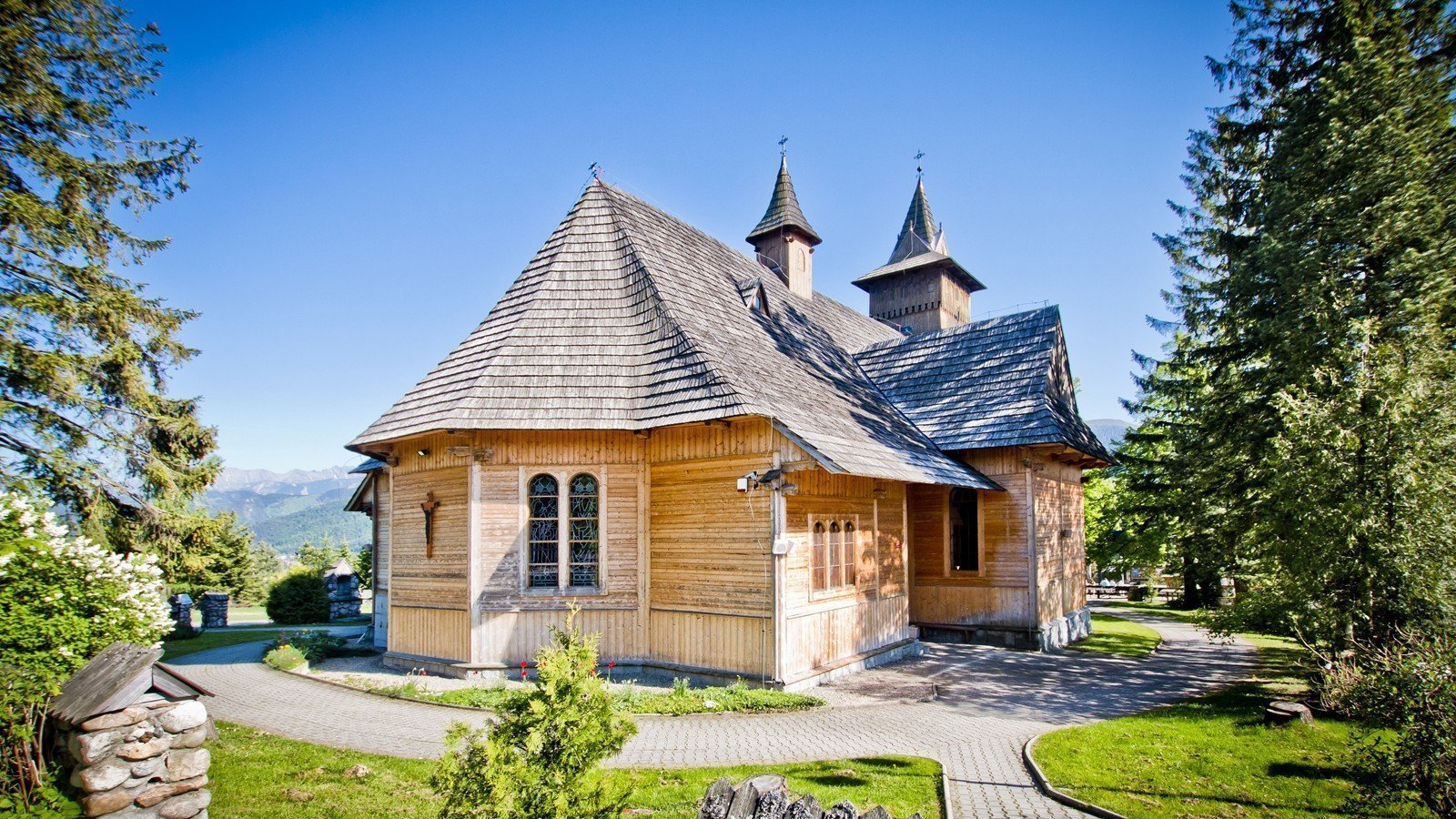
Engineer Eugeniusz Wesołowski, a student of Witkiewicz, designed the church in the Zakopane style. The wood for construction was donated from his forest by Count Władysław Zamoyski. Construction work began in 1908. The church, in the shape of a cross, includes two chapels, a presbytery, a choir, two sacristies, and has a tower and a small bell tower.
The stained glass windows were designed by Stefan Matejko, nephew of Jan Matejko. They were made by the famous Kraków studio of the Żeleński family. They depict: the Mother of God - funded by Marie(s) from the parish, St. John - funded by the Johns from the parish, St. Anne - funded by the Annes from the parish, and St. Joseph - funded by the Josephs from the parish.